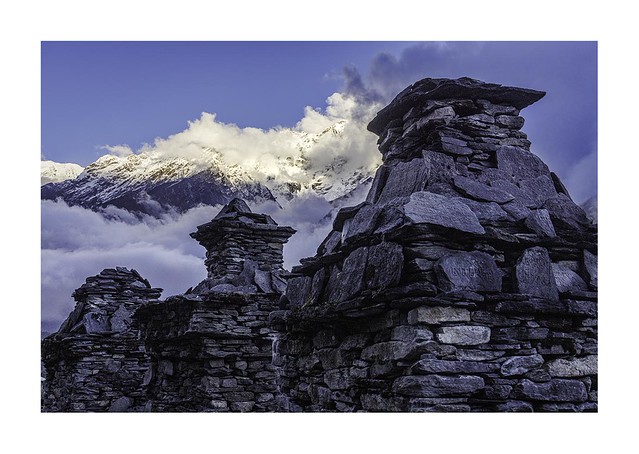
Before I trekked the Manaslu Circuit, I thought of it primarily as a mountain trek. Big views, high passes, Himalayan scenery. I did not expect to spend a morning frozen on a ridge watching blue sheep graze fifty meters away, or to emerge from a bamboo forest to find fresh pug marks in the mud that my guide identified immediately as snow leopard.
The Manaslu Conservation Area contains over 3,200 plant species and protects one of the most biodiverse Himalayan ecosystems in Nepal. This is not just backdrop. It is a living wild place.
Mammals
Snow Leopard (Panthera uncia)
The ghost of the Himalayas. An estimated 35–50 snow leopards inhabit the Manaslu Conservation Area. I did not see one — very few trekkers do — but those pug marks in the mud above Samdo were enough. The knowledge that they are there, watching from ridgelines and cliff faces, changes how you walk through the high country.
Best chance of a sighting: winter months (December–February), at elevations above 3,500m, early morning or dusk. Spotting scope or 400mm+ telephoto essential.
Blue Sheep / Bharal (Pseudois nayaur)
If you are paying attention above 4,000m, you will see these. Groups of 10–30 are common on rocky slopes, particularly around Samdo and the Larke Pass approach. They are remarkably unbothered by trekkers at distance — I watched a group for 45 minutes from a boulder while they grazed their way across a cliff face.
Himalayan Tahr (Hemitragus jemlahicus)
A wild mountain goat with a shaggy reddish-brown coat and curved horns. Common on steep rocky terrain in the 2,500–4,500m range. Often seen in small groups. Their sure-footedness on vertical terrain is genuinely astonishing.
Red Panda (Ailurus fulgens)
The Manaslu Conservation Area offers real possibility for red panda sightings in bamboo and rhododendron forests between 2,000–4,000m. They are shy and mostly active at dawn and dusk. Look in bamboo thickets and the branches of large rhododendron trees. The lower sections of the trail — particularly between Soti Khola and Philim — pass through appropriate habitat.
Musk Deer (Moschus chrysogaster)
Shy and largely nocturnal, occasionally seen in forested sections in early morning. Males carry the valuable musk gland that has made them a poaching target historically — the Conservation Area's protected status is critical for this species.
Himalayan Monal (Lophophorus impejanus)
Nepal's national bird. The male is spectacular — iridescent plumage that shifts between green, blue, red, and gold depending on the light. I flushed a pair from a rhododendron thicket near Namrung and watched them glide down the valley with their wings spread. Unforgettable.
Birds of the High Country
| Species | Altitude | Notes | |---|---|---| | Himalayan Monal (Danphe) | 2,500–4,500m | Nepal's national bird, unmistakable male plumage | | Lammergeier (Bearded Vulture) | All elevations | Massive wingspan, bone-crushing habit | | Griffon Vulture | All elevations | Often seen soaring in thermals near cliffs | | Snow Partridge | Above 4,000m | Ground-nesting, well-camouflaged | | Tibetan Snowcock | Above 4,500m | Loud call, seen near Larke Pass | | Blood Pheasant | 3,000–4,500m | Colorful, found in rhododendron forest |
Flora: The Living Landscape
Rhododendron Forests
The Manaslu Conservation Area contains eight species of rhododendron, including tree rhododendrons that can reach twelve meters in height. The bloom period — typically March through April — turns entire hillsides red, pink, and white. Trekking through a rhododendron forest in full bloom is one of the most visually overwhelming experiences the Himalayas offer.
Bamboo Zones
The lower sections of the trail (1,500–2,500m) pass through bamboo forest — dense, green, and cool. This is red panda country. It is also the habitat of multiple orchid and fern species.
Alpine Meadows (Bugyal)
Above 3,500m, the tree line gives way to open alpine meadows. In late spring and early summer, these meadows are carpeted with wildflowers: edelweiss, gentian, primrose, and dozens of other species. By October, the meadows have gone gold and brown, with a different beauty.
Yarsagumba: The Gold of the High Mountains
Above 4,000m, local communities harvest yarsagumba — Ophiocordyceps sinensis, a parasitic fungus that infects caterpillar larvae. It is one of the most valuable natural substances by weight in the world, used extensively in traditional Tibetan and Chinese medicine. You will see local collectors in the high valleys during harvest season (May–June), bent over the ground with small tools. It funds community livelihoods and is tightly regulated within the Conservation Area.
How to See More Wildlife
- Walk quietly and slowly. Speed kills sightings.
- Start moving at dawn. Most mammals are most active in the first two hours of daylight.
- Hire a guide who knows the terrain. Mine spotted a pika, a Himalayan tahr, and a blood pheasant that I would have walked past entirely.
- Carry binoculars. A 10x42 pair fits easily in a pack and transforms distant slopes into something observable.
The Manaslu Circuit is not just a mountain trek. It is a journey through one of the most intact wild ecosystems remaining in the Himalayas. Walk through it with attention.