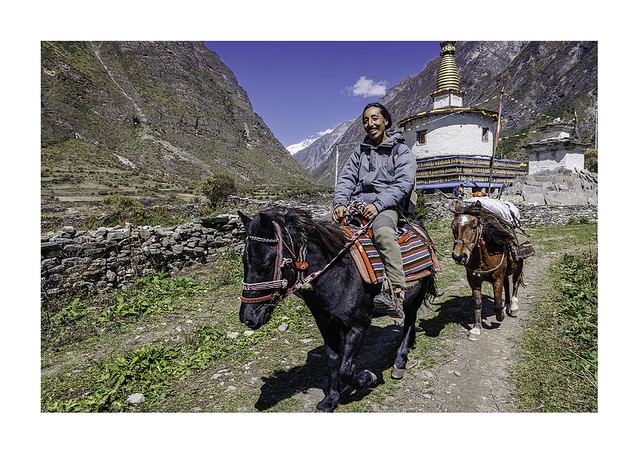
I have been trying to explain the Manaslu Circuit to people since I got back.
I have used words like "remote," "wild," "cultural," "challenging." I have shown photographs. I have described the view from Larke Pass, the prayer flags at Samagaon, the first glimpse of Manaslu's north face from Lho village. People nod politely and say it sounds incredible.
It sounds incredible. It is more than that.
It Is Still Wild
The Manaslu Circuit became open to foreign trekkers relatively recently, and it has not been domesticated the way some of the more famous routes have. The trail is rougher. The signage is inconsistent. The tea houses are simpler. There are stretches where you are genuinely alone in the valley — not alone in a crowded park way, but alone in the way that matters: no other humans in any direction.
This is rarer than it sounds. Most great treks in Nepal now see thousands of trekkers per season. The Manaslu Circuit sees a fraction of that. The wilderness feeling is real.
The Mountains Are Overwhelming
Manaslu is the eighth-highest mountain on Earth at 8,163m. The circuit route takes you around it completely — you see its north face from Lho, approach its glaciers from Samagaon, and cross directly between the Manaslu massif and the Annapurna range at Larke Pass.
There is a particular quality to being in the presence of an 8,000m mountain. It is not just size — it is the way it dominates the entire sky, changes the weather around it, and creates its own gravity in the landscape. Standing below Manaslu at Samagaon, looking up at a face that rises 4,600 vertical meters above you, is one of those experiences that recalibrates your sense of scale permanently.
The Culture Is Alive
The upper Manaslu valley is not a cultural museum. It is a living community. The Tibetan Buddhist villages of Lho, Samagaon, and Samdo are places where people wake before dawn to do kora, where children learn Tibetan script in small schools, where yak herders have moved between valley and high pasture for generations.
Trekking through this world slowly — not as a day visitor but as someone who spends nights and shares meals and drinks tea in the same rooms — gives you something tourism cannot manufacture: a brief, genuine membership in a place.
What You Carry Home
- The sound of a prayer wheel spinning in a courtyard at sunrise
- The weight of looking at a mountain that has killed people who were far better climbers than you
- The particular exhaustion of crossing 5,160m at dawn after walking for two weeks to get there
- The name of a tea house owner's daughter, learned over a shared plate of dal bhat
- The memory of prayer flags against a sky so blue it hurts to look at
It Changes Your Body
Two weeks of 1,000m daily elevation gain and loss changes your legs. Crossing Larke Pass changes your lungs. Spending fifteen days at altitude changes your relationship with oxygen, and by extension, with comfort, exertion, and your own capacity.
Most trekkers come back lighter, stronger, and with a recalibrated sense of what is difficult and what is merely inconvenient.
The Numbers Tell Part of the Story
| Factor | Detail | |---|---| | Distance | ~177km total circuit | | Duration | 14–17 days typical | | Highest point | Larke Pass, 5,160m | | Mountain surrounded | Manaslu, 8,163m — world's 8th highest | | Protected area | Manaslu Conservation Area — 1,663 sq km | | Wildlife residents | Snow leopard, red panda, snow leopard, blue sheep and more | | Cultural character | Tibetan Buddhist — gompas, mani walls, prayer flags throughout |
Why "Once in a Lifetime"
Not because you cannot go back. Some people do. But because the first crossing of the Manaslu Circuit happens to you in a way that is complete — a two-week immersion in altitude, culture, wildness, and physical challenge that leaves a clear before-and-after mark on your sense of what you are capable of.
I came home and found that my threshold for complaining about ordinary discomfort had raised significantly. I found that I remembered the faces of the people I met on the trail more clearly than the faces of people I see weekly. I found that looking at the mountains in any photograph, no matter how small, made me feel something specific that I had not felt before.
The Manaslu Circuit gave me a version of myself I had not met yet. That is what once-in-a-lifetime means.